
17 Jun 2026
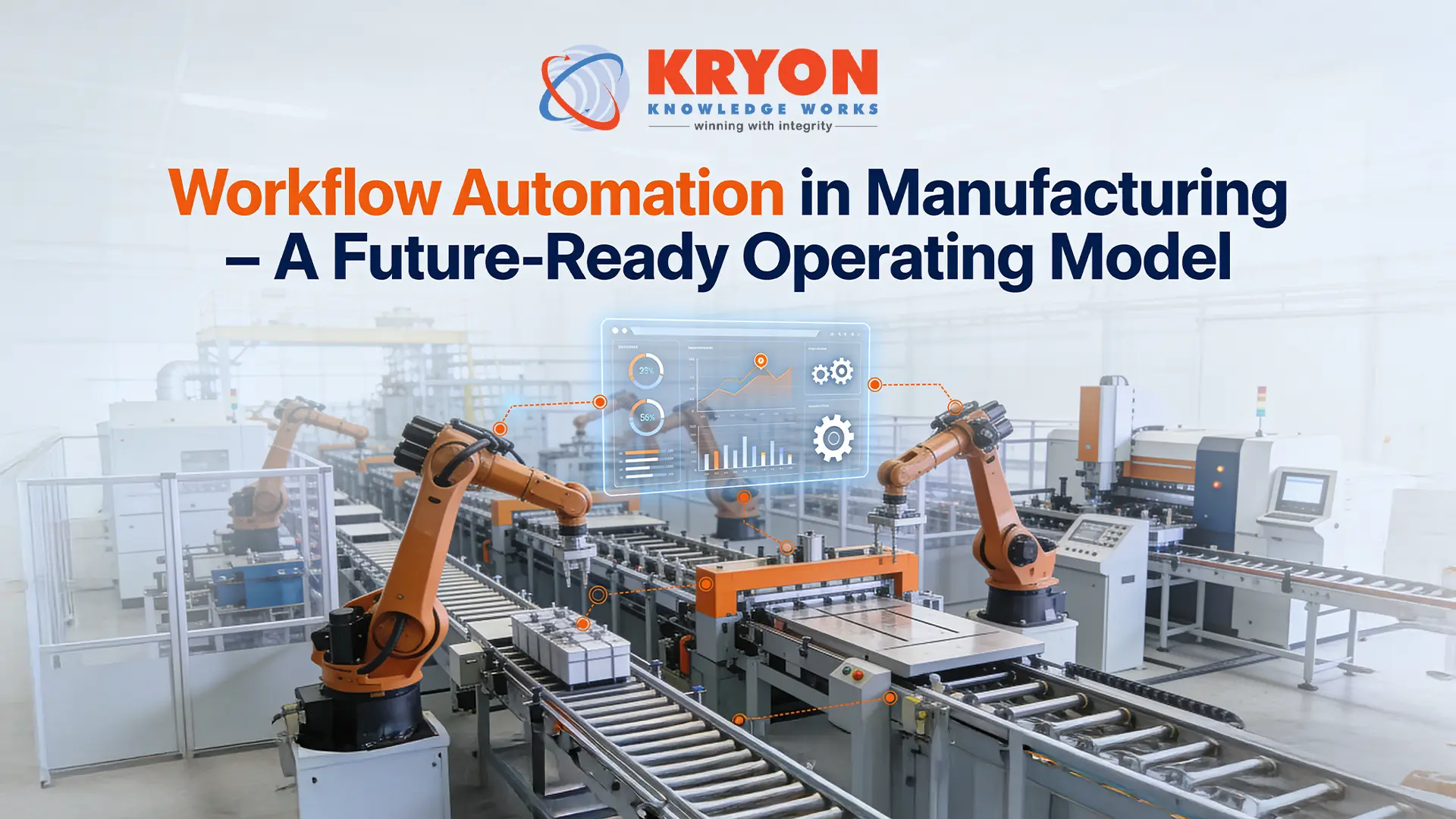
Manufacturing enterprises today operate in an environment where operational speed, production efficiency, and supply chain responsiveness directly impact business performance. However, many organizations continue to rely on disconnected systems and manual coordination across production planning, procurement, inventory, and quality management functions.
This often results in operational delays, limited visibility, inefficient resource utilization, and slower decision-making.
Kryon Knowledge Works will enable manufacturers to address these challenges through workflow automation and integrated operational systems that connect production processes into a unified digital ecosystem.
A manufacturing enterprise operating across multiple production units is experiencing recurring operational inefficiencies due to fragmented workflows and manual coordination between departments.
When a customer order is received, the production cycle currently involves multiple disconnected activities:
Because these processes operate independently, delays occur throughout the manufacturing lifecycle.
The organization is facing:
As demand continues to grow, the existing operating model is becoming increasingly difficult to scale efficiently.
Kryon Knowledge Works will implement an integrated workflow automation framework connected with the organization’s ERP, MES, inventory management, and shop floor systems.
The proposed solution will establish a unified operational workflow where systems automatically communicate and trigger downstream processes in real time with minimal manual intervention.
The implementation will focus on:
The objective is to create a connected manufacturing environment that improves operational efficiency, visibility, and responsiveness across the production lifecycle.
Once a customer order is confirmed in the ERP system, the automated workflow will initiate the next stages of execution.
| Process Stage | Workflow Action |
|---|---|
| Order Confirmation | Production workflow automatically initiated |
| Production Planning | Resource and machine allocation generated |
| Inventory Validation | Material availability checked in real time |
| Procurement Management | Purchase requests triggered automatically for low inventory |
| Production Execution | Shop floor activities monitored continuously |
| Quality Management | Automated alerts generated for defects or deviations |
| Dispatch Coordination | Logistics workflows triggered after production completion |
The workflow framework will continuously synchronize operational data across departments to ensure all stakeholders operate with the same real-time information.
Following implementation, the organization is expected to experience significant improvements in operational coordination and workflow efficiency.
Production planning cycles will become faster and more responsive to demand changes. Procurement coordination will improve through automated inventory-based triggers, reducing delays caused by manual approvals.
Real-time visibility across production units will enable operational teams to monitor workflow status continuously, while automated quality monitoring mechanisms will help identify and address issues earlier in the production process.
The proposed workflow model will also reduce dependency on manual communication and repetitive administrative activities across departments.
As manufacturing ecosystems continue to evolve, workflow automation will increasingly shift toward intelligent and predictive operations.
The future operating environment will enable:
This evolution will allow manufacturing enterprises to move from reactive operational models toward intelligent, data-driven manufacturing ecosystems.
The implementation of workflow automation is expected to create measurable operational and strategic improvements across the organization.
Expected outcomes include:
More importantly, the organization will establish a stronger digital operational foundation capable of supporting future manufacturing transformation initiatives.
Workflow automation is becoming a critical enabler for modern manufacturing enterprises seeking greater efficiency, operational visibility, and scalability.
By implementing an integrated workflow ecosystem, manufacturers can streamline production processes, improve coordination between systems and teams, and reduce operational bottlenecks caused by manual workflows.
Kryon Knowledge Works will support this transformation by enabling connected, automated, and future-ready manufacturing operations through workflow orchestration, enterprise integration, and intelligent operational frameworks.
If you are looking to modernize manufacturing operations through workflow automation, intelligent system integration, and scalable digital transformation strategies, Kryon Knowledge Works can help build a connected manufacturing ecosystem aligned with your operational and business goals.
2026 © Kryon Knowledge Works. All Rights Reserved