08 Oct 2026
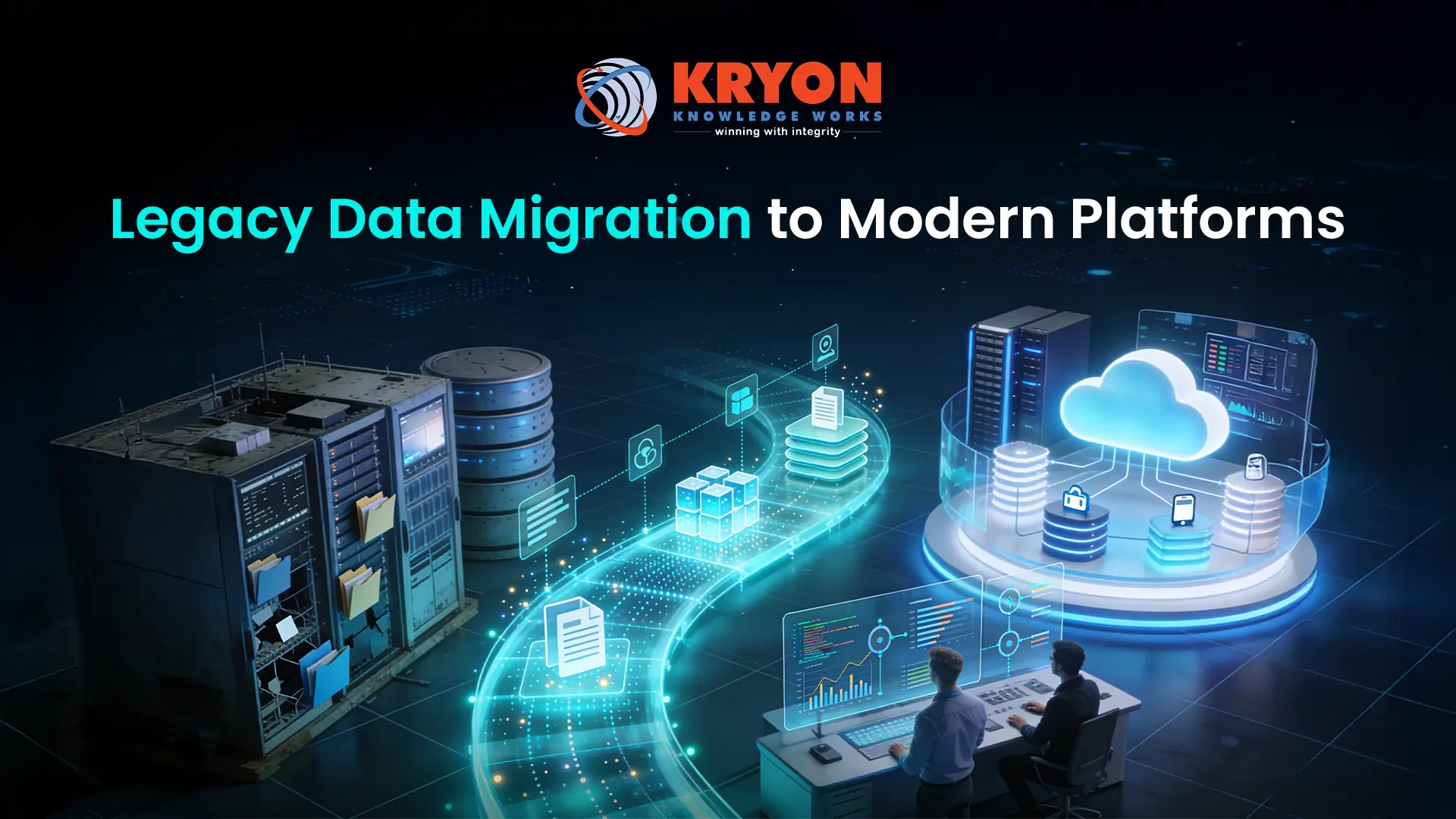
Legacy systems often hold years of critical business data even when the technology supporting them has become difficult to maintain. As organisations modernize applications, migrate to the cloud, or adopt new enterprise platforms, transferring this data becomes an important part of the transformation.
Data migration is not simply about moving records from one system to another. Legacy environments may contain duplicate records, inconsistent formats, outdated structures, missing information, and complex relationships between datasets.
Without a structured migration process, organisations may face incorrect data mapping, loss of relationships between records, migration errors, and disruption to business operations.
A controlled approach can help organisations move data while maintaining accuracy, integrity, traceability, and business continuity throughout the transition.
Kryon Knowledge Works can support organisations in planning and implementing a structured legacy data migration approach, based on their existing systems, target platforms, data requirements, and modernization goals.
The approach can include understanding the existing data environment, defining migration requirements, preparing and transforming data, executing migration in controlled stages, validating migrated information, and supporting the transition to the modern platform.
The migration process can begin by understanding where critical data resides and how it is structured across legacy systems.
Data sources, relationships, dependencies, formats, and quality issues can be reviewed before migration planning begins. This assessment can also help identify duplicate, obsolete, incomplete, or inconsistent records that may require attention.
Understanding the existing environment helps determine what needs to move, what needs to change, and what information may no longer be required.
Legacy and modern systems often organize information differently. Fields, schemas, identifiers, and relationships may not have direct equivalents.
Data mapping can define how information from the source environment should be represented within the target platform. Where necessary, transformation rules can be established for information that requires restructuring, normalization, consolidation, or format conversion.
This provides a clearer foundation for transferring data between different technology environments.
Moving existing data without addressing quality issues can carry legacy problems into the new platform.
Before migration, data can be reviewed for duplicate records, invalid values, missing information, and inconsistent formats. Where required, transformation processes can prepare the information for the structure and requirements of the target system.
This helps improve the usability and consistency of data after migration rather than simply transferring existing records as they are.
Rather than moving all information at once, migration can be planned and performed through controlled stages.
Pilot migrations can help test mapping and transformation rules using selected datasets before larger volumes are transferred. Issues identified during these tests can then be reviewed before proceeding with broader migration activities.
Depending on the organisation's systems and operational requirements, approaches may include phased migration, parallel operation, or a planned cutover.
Migration does not end when data reaches the target platform. Validation is important for determining whether information has been transferred as intended.
Migrated information can be compared with the source environment to review record counts, field mappings, relationships, required values, and applicable business rules.
Migration logs and exception reports can also help identify records requiring further investigation or correction before the new platform becomes fully operational.
Once the migrated data has been reviewed and validated, the transition to the modern platform can move into the cutover and stabilization stage.
Depending on the migration strategy, this can involve final synchronization, transition planning, issue resolution, and post-migration monitoring.
Legacy environments can then be retained, archived, or decommissioned according to the organisation's operational, security, compliance, and data-retention requirements.
A structured migration approach can help organisations modernize their technology environments while maintaining greater control over critical business data.
Addressing data quality, mapping, and transformation before migration can reduce the risk of carrying unnecessary or inconsistent information into the new environment. Controlled migration and validation can also provide better traceability throughout the transition.
The migration lifecycle can follow a clear path:
This approach can help organisations move toward modern platforms while preserving the usability and continuity of the data their applications and business processes depend on.
Successful modernization involves more than replacing legacy applications or infrastructure. The data behind those systems also needs to be understood, prepared, transferred, and validated carefully.
At Kryon Knowledge Works , we help organisations approach legacy modernization with the right software, data, cloud, and integration capabilities. Depending on the technology environment, this can include support for data assessment, migration planning, transformation, validation, and transition to modern platforms.
2026 © Kryon Knowledge Works. All Rights Reserved