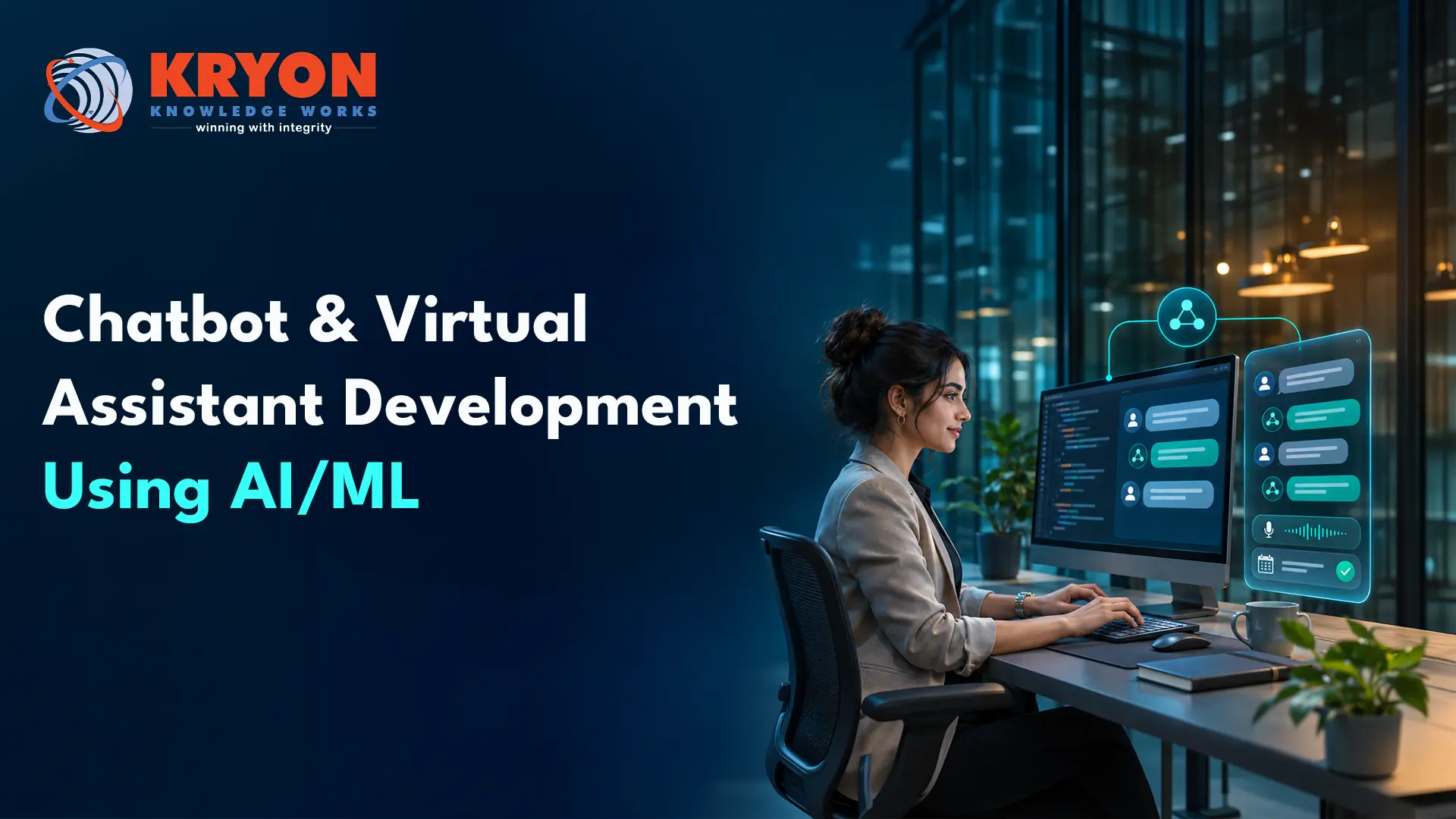
Organizations often manage high volumes of repetitive queries from customers, employees, and internal teams. Heavy dependence on manual support can increase response times, create inconsistent service experiences, and place additional workload on support teams.
The requirement will be to develop an intelligent conversational solution that can understand user requests, retrieve relevant information, support routine interactions, initiate approved workflows, and appropriately escalate complex queries to human teams.
Kryon Knowledge Works will propose and develop AI/ML-powered chatbots and virtual assistants based on specific business requirements, user scenarios, information sources, and existing technology environments.
Depending on the use case, the solution can combine Natural Language Processing (NLP), Large Language Models (LLMs), conversational AI, Retrieval-Augmented Generation (RAG), enterprise APIs, knowledge management, and workflow automation.
The virtual assistant can be integrated with web applications, mobile platforms, internal portals, and relevant enterprise systems based on defined integration and security requirements.
Identify common user queries, target user groups, business processes, information sources, conversation scenarios, escalation requirements, and system integrations.
This will help define where conversational automation can provide practical value and where human involvement should remain part of the process.
Implement appropriate NLP and AI capabilities to interpret user intent, understand conversational context, and identify the information or action required.
The specific AI approach will depend on the complexity of the use case, available data, accuracy requirements, and existing enterprise environment.
Connect the virtual assistant with approved knowledge bases, databases, document repositories, APIs, CRM platforms, and enterprise applications where required.
For knowledge-intensive use cases, techniques such as RAG can be considered to retrieve relevant information from authorized enterprise sources and provide it as context for response generation.
Design conversational workflows that use available and authorized context to provide relevant responses while operating within defined business, data-access, and security rules.
Conversation design can also account for follow-up questions, incomplete information, unsupported requests, and situations requiring clarification.
Enable the assistant to perform approved and authorized actions such as retrieving information, creating service requests, checking status, scheduling activities, updating permitted records, or initiating predefined business workflows.
Access to enterprise systems and actions will be governed by appropriate permissions and business rules.
Route requests requiring additional expertise, judgment, approval, or authorization to the appropriate human team.
Where supported by the workflow, relevant conversation context can be transferred with the request to help reduce unnecessary repetition for users and support teams.
Apply appropriate authentication, authorization, least-privilege access, data protection, and system permissions based on the information and actions available through the virtual assistant.
Where LLM or generative AI capabilities are used, additional safeguards can be considered for risks such as prompt injection, inappropriate tool access, sensitive information exposure, and unauthorized actions.
Evaluate the solution against defined conversation scenarios, expected responses, system integrations, authorization rules, workflow actions, and escalation conditions.
Human validation can remain part of the process for sensitive, complex, or higher-impact interactions.
Monitor interactions, unresolved queries, response quality, usage patterns, workflow failures, and escalation trends to identify opportunities for controlled evaluation and ongoing improvement.
Updates can then be introduced based on validated business requirements rather than assuming the system will automatically learn correctly from every interaction.
Support routine customer enquiries, service requests, status checks, and information retrieval while directing complex or sensitive requests to appropriate support teams.
Provide employees with convenient access to approved organizational information, policies, procedures, internal services, and frequently requested information.
Support common technical queries, provide guided troubleshooting, retrieve relevant knowledge articles, create service requests, and escalate more complex incidents where required.
Assist employees with routine queries related to onboarding, leave procedures, organizational policies, documentation, and other approved HR processes.
Help customers or internal users find relevant information about products, services, processes, features, and support resources through guided conversational interactions.
Provide conversational access to information contained within approved documents, knowledge repositories, databases, and connected enterprise systems.
Support selected internal processes by retrieving information and initiating predefined, authorized actions through integrations with relevant business applications.
Depending on implementation, integration, adoption, and business requirements, the proposed solution can help organizations:
Depending on the use case and existing technology ecosystem, the solution can incorporate:
AI/ML, NLP, LLMs, Conversational AI, RAG.
Enterprise APIs, System Integration, Workflow Automation.
Authentication, Authorization, Access Control.
Analytics, Performance Monitoring, Continuous Evaluation.
The final technology architecture will depend on the organization's business requirements, existing systems, data availability, security policies, integration requirements, and deployment environment.
AI/ML-powered chatbots and virtual assistants can move beyond basic question-and-answer interfaces to support a broader conversational layer connecting users with enterprise knowledge, services, and approved workflows.
The effectiveness of such solutions will depend not only on the AI model but also on the quality of enterprise information, system integrations, conversation design, security controls, authorization boundaries, testing, monitoring, and appropriate human oversight.
Kryon Knowledge Works will support organizations in designing and developing business-focused conversational solutions with security, scalability, enterprise integration, workflow automation, and user experience requirements considered throughout the solution architecture.
2026 © Kryon Knowledge Works. All Rights Reserved