
25 Mar 2026
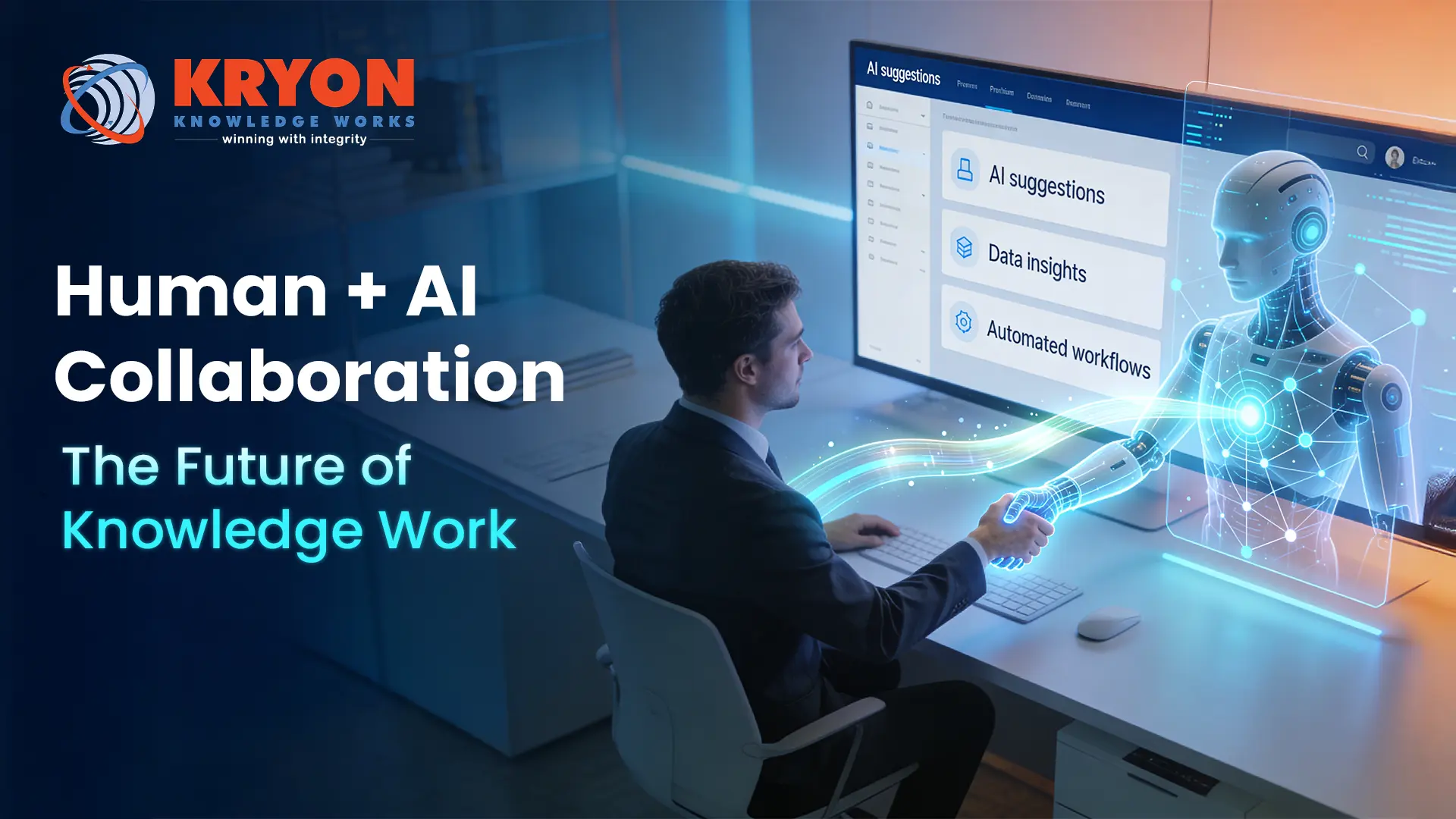
In today’s rapidly evolving digital landscape, the conversation is no longer about humans vs. machines—it is about humans working with AI to unlock unprecedented levels of productivity, intelligence, and innovation.
The visual you shared captures this shift perfectly: a seamless interaction between human decision-making and AI-driven execution. But beyond the imagery lies a deeper transformation that is reshaping how organizations operate, create, and scale.
Human + AI collaboration is a hybrid working model where:
Together, they create smarter, faster, and more reliable workflows.
For years, automation focused on replacing repetitive tasks. Today, AI has evolved into a collaborative intelligence layer—augmenting human capabilities rather than replacing them.
This shift is redefining knowledge work across industries—from publishing and healthcare to finance and enterprise IT.
One of the most powerful aspects of this collaboration is its impact on decision-making. In many organizations, decisions are delayed due to lack of visibility or fragmented information.
AI addresses this by providing contextual suggestions and insights. It analyzes data, identifies patterns, and presents recommendations that help professionals make informed decisions faster. Rather than replacing human judgment, it enhances it—reducing uncertainty and improving confidence in outcomes
Data alone does not create value. The real value lies in how effectively it is used. Many organizations struggle with large volumes of unstructured or underutilized data.
AI changes this dynamic by converting data into meaningful insights. It highlights trends, predicts outcomes, and enables proactive decision-making. This allows organizations to move from reactive problem-solving to strategic planning, improving both efficiency and performance.
Workflows are at the heart of every organization. However, traditional workflows are often manual, fragmented, and difficult to scale.
With Human + AI collaboration, workflows become more structured and intelligent. Repetitive tasks are automated, processes are streamlined, and actions are guided by real-time insights. This not only reduces manual effort but also ensures consistency and accuracy across operations.
Over time, these systems learn and improve, making workflows more efficient with each iteration.
Despite the capabilities of AI, human involvement remains essential. AI can process data and provide recommendations, but it cannot fully understand context, ethics, or strategic priorities.
Humans play a critical role in validating outputs, making complex decisions, and guiding overall direction. This balance ensures that technology is used effectively without compromising quality or accountability.
Human + AI collaboration is therefore not about dependency—it is about partnership.
The benefits of this collaboration are visible across multiple sectors. In publishing and research workflows, AI supports faster manuscript processing, reviewer coordination, and metadata generation. In enterprise environments, it enables better workflow management, improved visibility, and enhanced productivity.
Across industries, the outcome is consistent: faster execution, improved accuracy, and the ability to scale operations without increasing complexity.
While the potential is significant, implementation is not without challenges. Many organizations operate with disconnected systems, manual processes, and limited data visibility. Without proper integration, AI cannot deliver its full value.
To succeed, organizations need structured workflows, unified platforms, and a clear strategy for integrating AI into their operations. The focus should not be on adopting technology alone, but on creating an ecosystem where humans and AI can work seamlessly together.
Human + AI collaboration is not a temporary trend—it is the foundation of future work environments. As technology continues to evolve, the relationship between humans and AI will become even more integrated.
Organizations that embrace this collaboration will gain a significant advantage. They will operate faster, make better decisions, and deliver higher-quality outcomes.
The future of knowledge work lies in this partnership—where human intelligence and artificial intelligence come together to create systems that are not only efficient, but also adaptive, scalable, and intelligent.
2026 © Kryon Knowledge Works. All Rights Reserved